- 21/11/2026
- Rohit Mishra
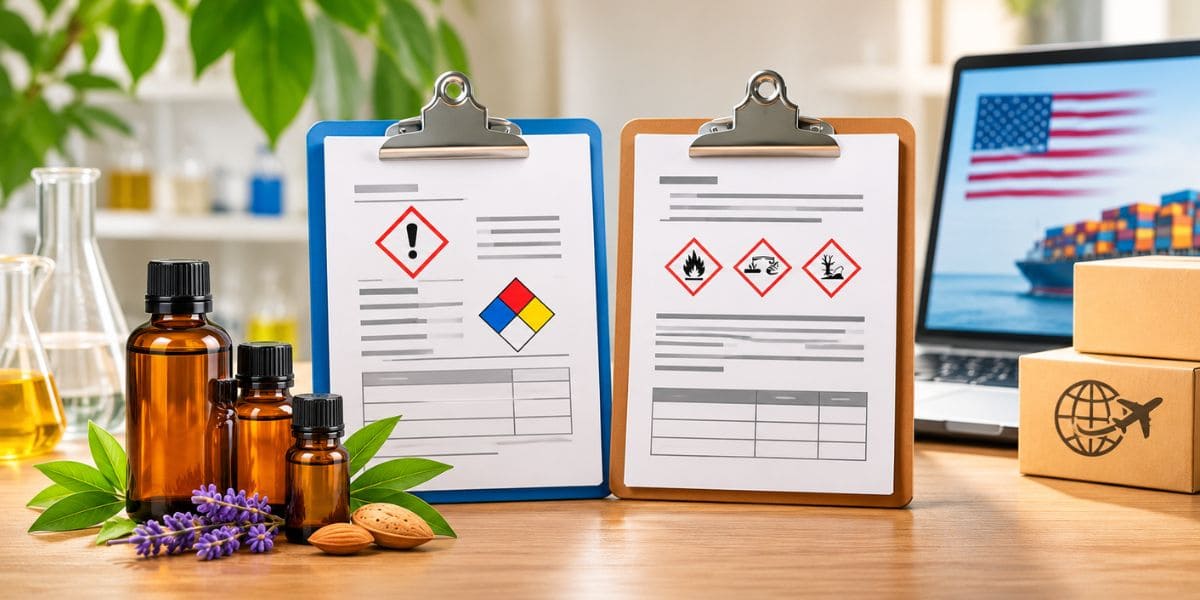
When purchasing essential oils, especially in bulk, it’s vital to seek safety documentation. Customers may encounter both SDS (Safety Data Sheet) and MSDS (Material Safety Data Sheet) terms. An SDS is a modern, standardized version of the MSDS. Familiarity with an SDS helps identify chemical hazards, prevent accidents, ensure proper storage of concentrated oils, and meet regulatory and supply-chain standards, even for natural products. Understanding safety data sheet essential oil documents is crucial for safety and compliance.
What Is an SDS, and What Does MSDS Mean?
SDS stands for Safety Data Sheet, and it is a thorough document that contains critical information regarding the hazards of chemicals, as well as safety precautions for their handling, storage, and disposal. MSDS stands for Material Safety Data Sheet, and it, like an SDS, is a document that contains thorough information about a chemical product’s possible hazards, as well as instructions for safe handling, storage and disposal. A safety data sheet for essential oils provides similar product-specific safety guidance.
The new SDS format replaces the old MSDS format. It was introduced by the redesigned OSHA Hazard Communication Standard to include new standardized terminology. Both documents cover chemical hazards, safe storage and emergency response.
SDS vs MSDS: What Is the Difference?
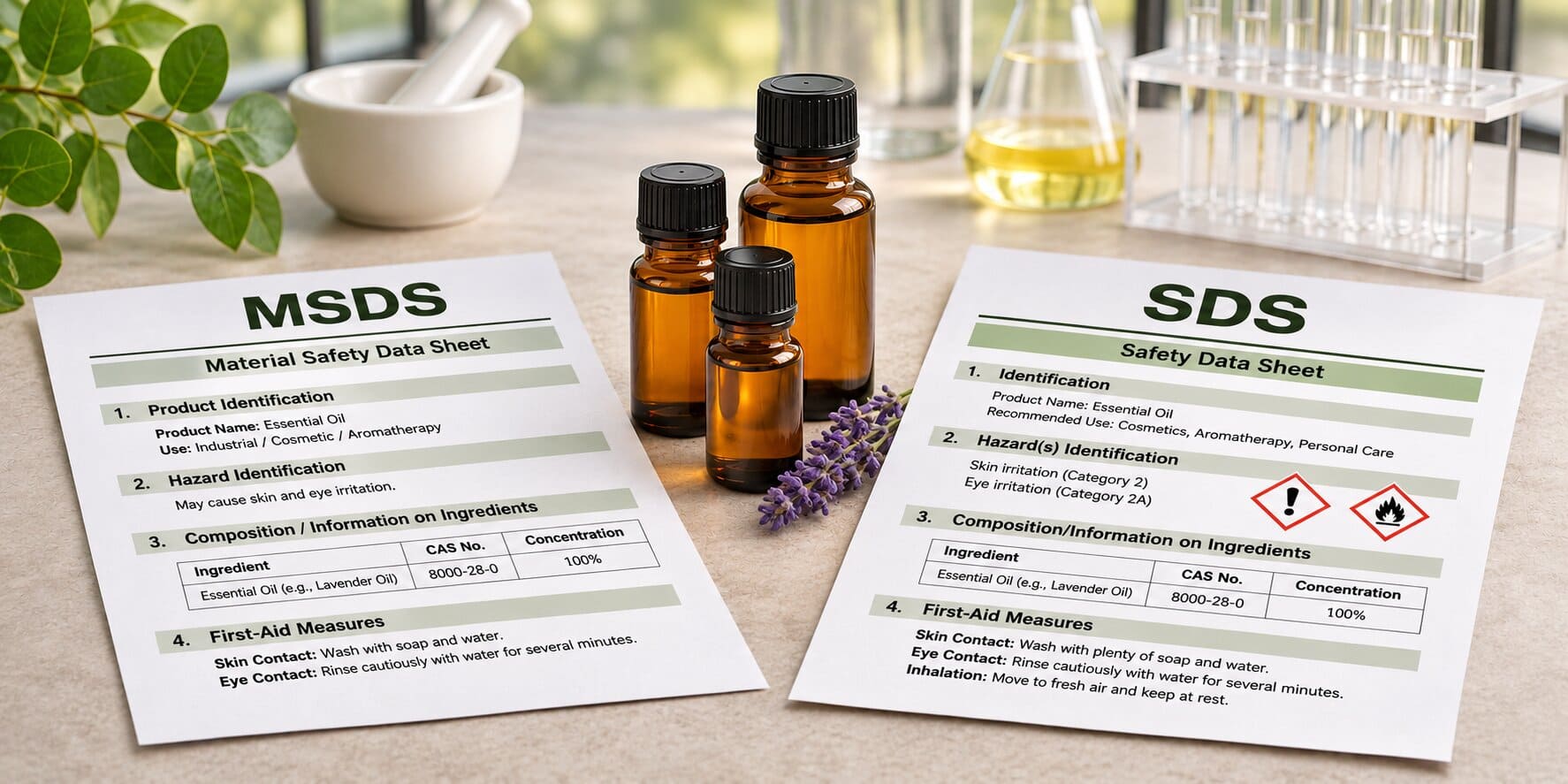
In MSDS vs SDS, the new Safety Data Sheets (SDS) are a uniform 16-section format, unlike the old 9-section format of MSDS. This allows for more standardization and less room for confusion when dealing with dangerous substances. OSHA revised its Hazard Communication Standard (HCS) to align with the Globally Harmonized System (GHS) and provided US manufacturers and distributors until 2015 to comply with the new HCS.
These OSHA safety data sheet requirements help ensure SDS documents present hazard information in a consistent and controlled format, helping employees access essential safety guidance. Standardized pictograms, labels, and precautionary statements also make chemical hazards and safe-handling instructions easier to understand.
Why Do Essential Oil Buyers Need a Safety Data Sheet?

Safety Data Sheets (SDS) can help bulk essential oil buyers in numerous ways, such as satisfying regulatory obligations, ensuring the safety of employees in the workplace and recognizing possible physical and health risks. These guidelines are necessary for proper selection of protective gear, proper handling, storage and transportation. It has also included first aid measures, firefighting measures, and emergency spill procedures to assist buyers in minimizing risks during manufacturing and distribution. An SDS supports informed safety practices when managing large oil quantities. However, it is a safety document, not proof of an essential oil’s purity, authenticity, or quality.
What Information Does an Essential Oil SDS Contain?
The basis for a standardized document for chemical safety, the Safety Data Sheet (SDS), is the Globally Harmonized System (GHS), which contains sixteen sections. It includes critical details on chemical dangers, safe storage and handling, emergency procedures and regulatory compliance.
Sections 1–3 cover product identification, hazard identification and chemical composition.
Sections 4–6 explain first aid, firefighting, and accidental release measures.
Sections 7–8 outline safe handling, storage, exposure controls and personal protective equipment (PPE).
Sections 9–11 detail physical and chemical properties, stability, reactivity, and toxicological information.
Sections 12–15 address ecological information, disposal, transportation and regulatory requirements.
Section 16 contains additional information, including document preparation and revision details.
OSHA’s Appendix D specifies the information required in Sections 1–11 and 16. Although Sections 12–15 are included in the standard SDS format, OSHA does not enforce these sections under its Hazard Communication Standard (HCS).
What Should US Buyers Check in an Essential Oil SDS?
US buyers should review an essential oil SDS to verify the correct product and botanical name, supplier or responsible-party details, and preparation or latest revision date.
- Check the warnings on the product, how transparent the ingredients are, the hazard classifications and emergency contact information.
- Always read the label carefully for instructions on proper storage, transportation, personal protective equipment (PPE), handling spills and first aid.
- Most importantly, confirm that all safety information matches the actual essential oil supplied.
- Request a revised SDS specific to your product rather than a generic one that applies to all essential oils. Check that it corresponds to the COA, IFRA and allergen declarations before you buy it.
Do All Essential Oils Have the Same SDS Requirements?
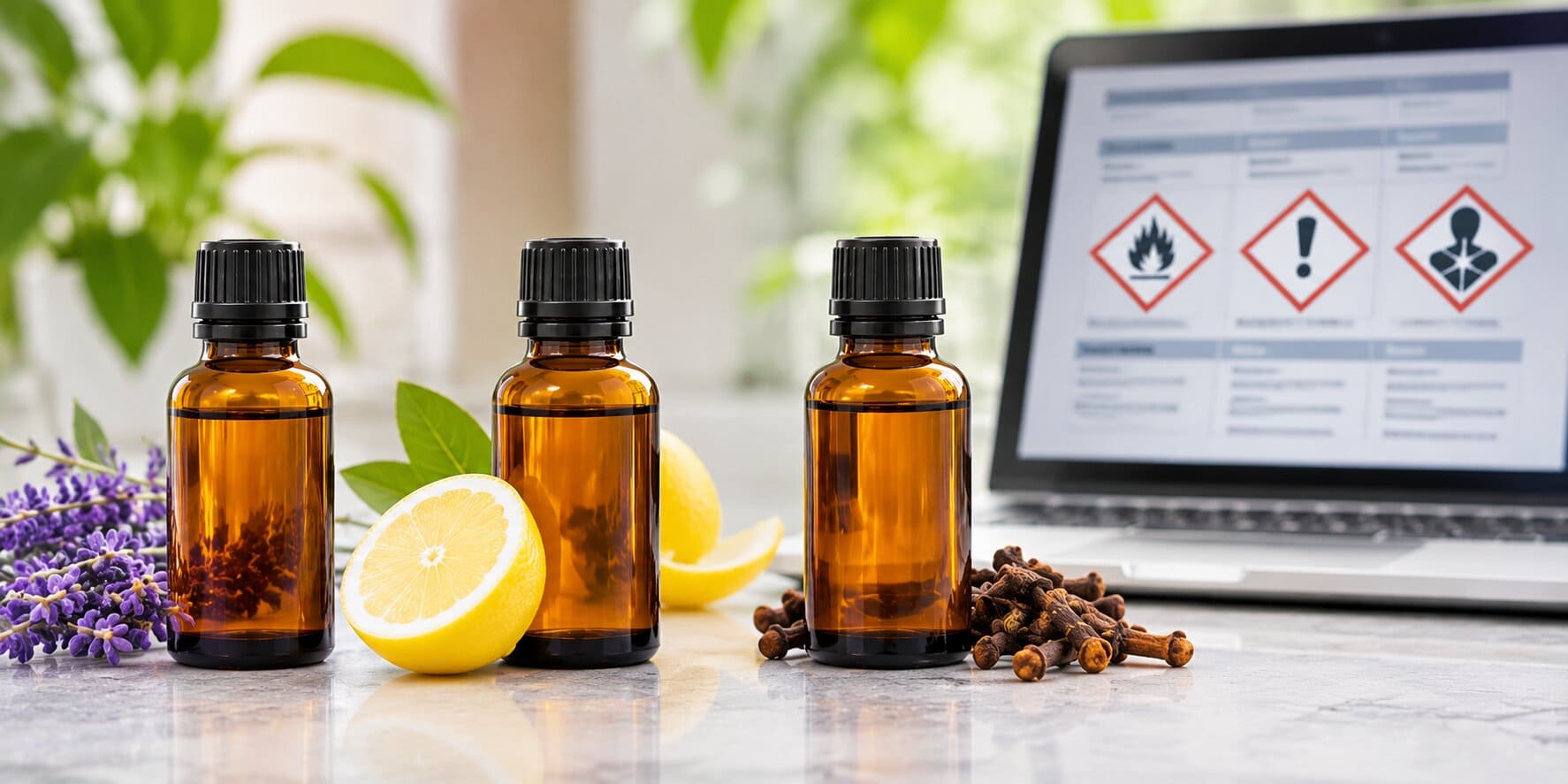
Some essential oils require a specific Material Safety Data Sheet (MSDS). Although many follow a 16-section format, the specific danger classifications and legal requirements differ based on the oil, grade, supplier and use. Variations in chemical composition can lead to different hazard classifications, including flammability and skin irritation. Buyers should not assume that one essential oil’s SDS applies to another, even from the same producer, due to these differences.
How to Request an SDS from an Essential Oil Supplier
Before placing a bulk order, share the exact product name and request the latest GHS-compliant, product-specific 16-section SDS. Confirm that the document matches the supplied oil’s botanical species, grade, batch, and intended use. Review hazard and transport details, ask the supplier to clarify unclear safety information and keep the approved SDS accessible to all employees handling the product.
Conclusion
Understanding SDS documentation is important when importing essential oils from an international supplier or producer into the United States. If you are a US bulk oils buyer, you should research the individual safety data sheets, hazard classifications and handling suggestions for the products before you purchase.
FAQs
1. Is an SDS the same as an MSDS?
MSDS and SDS both communicate chemical hazards and safe handling instructions; however, they are different. The new, uniform SDS format replaces essential oil MSDS terminology and format.
2. Is an SDS required for essential oils in the USA?
OSHA’s Hazard Communication Standard deals with toxic substances. An SDS is required for essential oils in the US based on the oil’s categorisation and applicable requirements.
3. What are the 16 sections of an SDS?
16 sections of an SDS address identification, hazards, composition, first aid, firefighting, spills, handling, exposure controls, physical properties, stability, toxicity, ecology, disposal, transportation, regulations and other topics
4. Can one SDS be used for all essential oils?
Different oil compositions require specific essential oil safety data sheets (SDS) due to variations in fire, health, and environmental risks, as generic labels do not adequately convey safety information for handling or emergencies.