- 25/11/2026
- Rohit Mishra
Skincare, haircare, aromatherapy, and personal care brands all use essential oils. Demand keeps rising in each of these areas. As a result, more businesses are buying essential oils in bulk. The supplier you pick shapes your product quality. It also shapes your brand reputation. A poor choice affects cost, consistency and delivery timelines.
Buyers usually choose between two sourcing options. These are an essential oil manufacturer and an essential oil trader. This essential oil manufacturer vs trader comparison covers quality, pricing, customization and supply. It helps you select the right bulk essential oil supplier. Each section gives clear, practical points for business buyers.
What Is an Essential Oil Manufacturer?
An essential oil manufacturer produces the oil itself. It controls each stage from plant material to finished product. Many manufacturers also operate as an essential oil wholesale supplier.
Production, Extraction Method and Processing
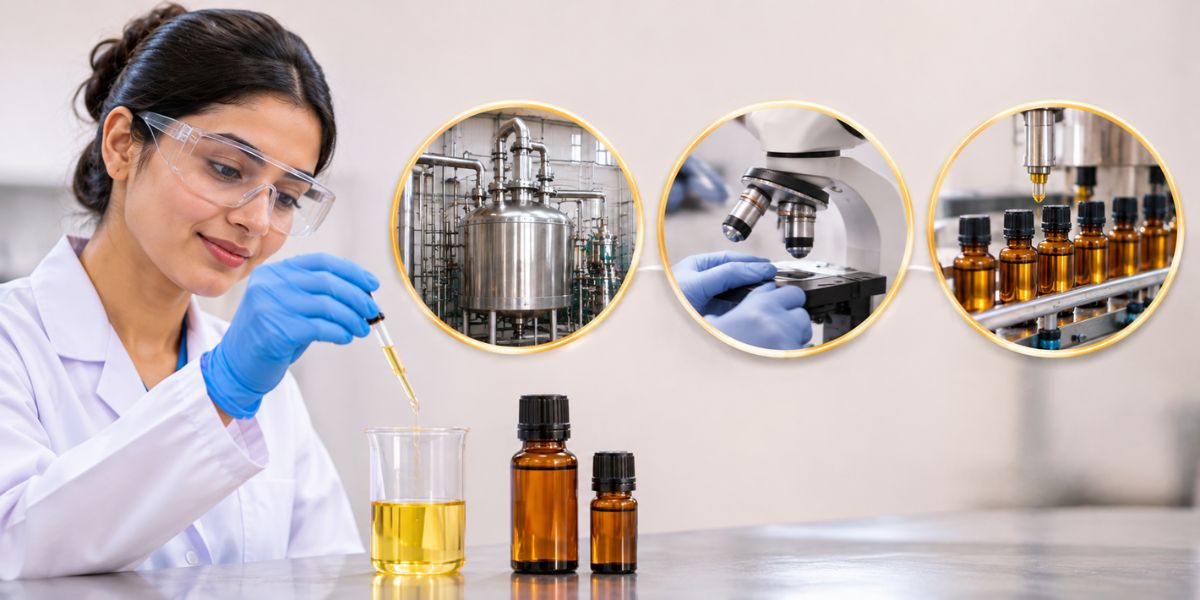
Manufacturers run extraction in-house. Common methods include steam distillation and cold pressing. The oil is then filtered and stored. UNIDO describes how oil moves through production, processing, and storage.
Quality Testing, Packaging and Customization
Manufacturers test each batch of oil. They pack it in bottles or drums. They can adjust blends, sizes and labels. This is suitable for private label and custom projects.
What Is an Essential Oil Trader?
An essential oil trader purchases oils from manufacturers, producers, or other suppliers and resells them to buyers. Traders act as intermediaries between producers and customers. They are also known as essential oil trading companies or essential oil distributors.

How Essential Oil Trading Companies Work
Essential oil traders source oils from multiple suppliers and maintain ready stock to meet buyer demand. A wholesale essential oil trader typically sells oils in smaller quantities and offers quick delivery. The UNECA report lists traders alongside producers and processors in the value chain.
Product Sourcing and Reselling Process
Oil from several suppliers makes batch origin harder to confirm. A bulk essential oil trader should share source documents. An essential oil trading supplier should do the same. CBI notes that both producers and re-exporters work in this trade.
Essential Oil Manufacturer vs Trader: Key Differences
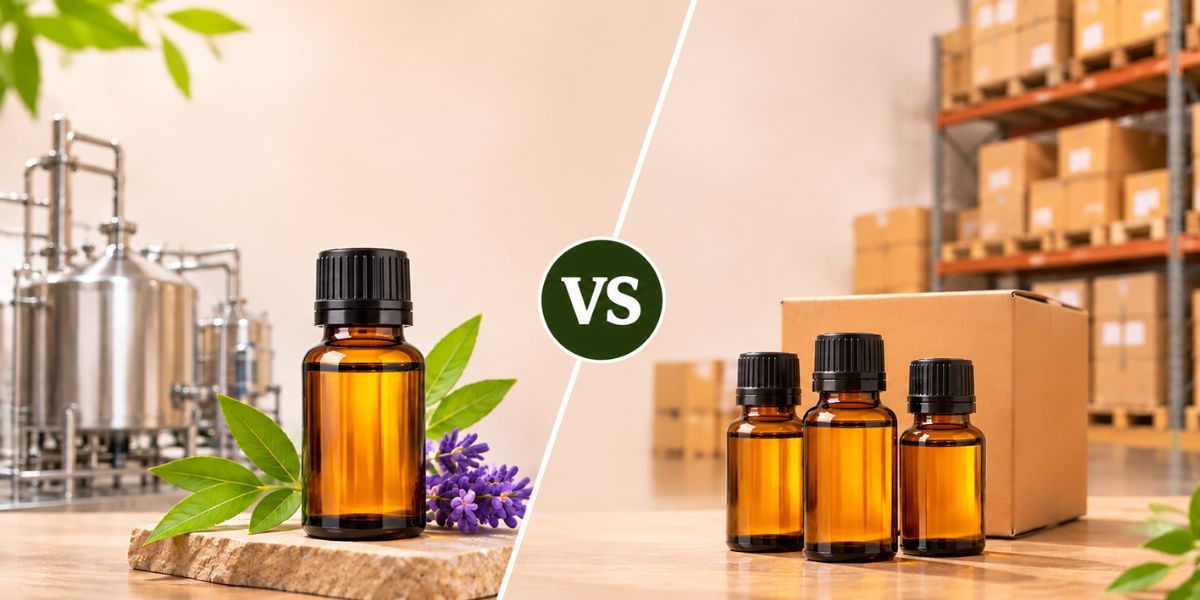
- A manufacturer tests its batches. It can link results to a specific production run. A trader usually relies on the original producer’s reports. Buyers should request those reports before ordering. Missing reports signal a sourcing risk.
- Essential oil wholesale pricing from a manufacturer usually suits bulk orders. There is no middle margin. A trader adds a margin to each lot. Small lots from a trader may still cost less overall. Buyers who buy essential oils wholesale should compare both models.
- Manufacturers can change blends, packaging, and labels for private label orders. They can develop custom formulations. Traders mostly sell ready stock. Custom requests are usually limited. Brands building their own line gain more flexibility from a manufacturer.
- A manufacturer knows how the oil was produced. Its team answers technical questions directly. A trader can only share what its source provides. Specification queries may take longer to resolve.
- Manufacturers plan production and commit to larger repeat orders. Traders can ship quickly from stock. Supply may change when their sources run out. Essential oil bulk buying with steady schedules suits manufacturers better.
- A manufacturer can usually trace oil to its source and batch. A CBI value chain study found that long supply chains reduce traceability. Each extra link adds uncertainty. Traders should provide origin records on request.
Which Is Better According to the Market?
Market reports do not name a single winner. CBI guidance shows that European buyers expect suppliers to organise technical documentation. They also expect safety data sheets and traceability. Suppliers who prove origin and quality hold the advantage. Manufacturers usually find this easier. A trader with full documentation can still be a sound choice.
| Comparison Factor | Manufacturer | Trader |
|---|---|---|
| Production | Produces and processes the oil | Buys and resells from other suppliers |
| Quality Control | Tests its own batches | Depends on the source’s reports. |
| Customization | Blends, packaging and private label | Limited, mostly ready stock |
| Pricing | Suited to bulk orders | Suited to small lots |
| Product Knowledge | Deep and first-hand | Depends on the source. |
| Supply | Planned repeat orders | Fast from stock, less predictable |
How to Choose the Right Essential Oil Supplier?

1. Check Product Purity and Quality Reports
Ask the supplier for specifications and lab reports first. CSIR-IIIM says essential oils are tested by GC and GC-MS profiling. Check those results against the specification. Do these checks before ordering bulk essential oils.
2. Ask for COA and Batch Details
Every batch should include a Certificate of Analysis and a batch number. This links the oil received to its test results. Reject batches without this documentation.
3. Verify Sourcing and Traceability
Ask suppliers about the origin of the plant materials and how the oil is sourced and delivered. Clear and transparent answers can help you identify a reliable supplier. Searches for wholesale essential oils near me may show many sellers, and searches for essential oil distributors near me can provide similar results. Always verify each supplier’s sourcing practices, product quality, and supply chain before making a purchase.
4. Compare MOQ and Bulk Pricing
MOQs differ between essential oil wholesalers and manufacturers, so compare them early. Also look at price breaks. Add packing and shipping to every quote. Only then do you see the true cost of bulk essential oils.
5. Check Certifications and Packaging Standards
Review certifications, labelling and packaging standards. CBI notes that documentation, labelling and packaging matter in export markets. Confirm these before shipment.
Why Choose Bo International For Essential Oil Manufacturing?
Bo International is an essential oil manufacturer in India. From start-ups to well-known brands and distributors, we offer private labelling and contract production. If you need a formulation under your own brand name, you can choose from over 3000 natural and naturally sourced ingredients to create your desired formulation.
Our R&D team can create bespoke formulations. We also handle packaging and product development in-house. Please get in touch to get a quotation for bulk or private label orders.
Conclusion
Manufacturers give you more control over quality, customization, and bulk supply. Depending on the required quality of product, desired quantity, and business objective, traders can be considered. Before purchasing large quantities, ensure that you have checked the supplier. Request documentation, information about batches, and traceability. The right documentation is equally essential. Bo International is one option for manufacturing private label or custom essential oils.
Frequently Asked Questions
1. What is the difference between an essential oil manufacturer and a trader?
A manufacturer makes the oil. A trader buys it from producers and resells it. Manufacturers offer more control over quality and customization.
2. Is buying essential oils directly from manufacturers more cost-effective?
For bulk orders, it often is. There is no middle margin. Price also depends on quality and volume. Compare the full cost and not only the per-kilo rate.
3. How can businesses check the quality of bulk essential oils?
Ask for a COA and a batch number. Request GC or GC-MS reports. Confirm where the oil comes from. Always test a sample before a bulk order.